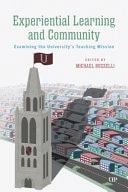
Experiential Learning and Community Examining the University's Teaching Mission
Institutional autonomy, private interests, and relevance are central themes in the evolving discourse on the nature and role of higher education. Whether pushing institutions to become more responsive to industry and labour market demands or resisting these very pressures, leaders and policymakers insist that universities must adapt. Experiential Learning and Community explores the changing role of the university, with a particular focus on how the rise of experiential learning (EL) is reshaping teaching and learning.
Through the lens of EL, universities are balancing two core principles: fostering an engaged citizenry and democracy, while also equipping learners with the skills needed for a prosperous economy. As EL rapidly expands in various forms – such as work-integrated learning like co-ops and internships, as well as community-engaged student placements such as service learning – universities are extending their reach far beyond the campus.
The book asks: Should universities fully embrace EL? If so, how can institutions and faculty adapt to this fundamental shift in their core mission? Are community partners now equal collaborators with a voice in pedagogy and curriculum? And perhaps most importantly, are students better served by this emergent EL approach to teaching and learning? Experiential Learning and Community addresses these questions when universities, communities, and learners urgently need answers.
Through the lens of EL, universities are balancing two core principles: fostering an engaged citizenry and democracy, while also equipping learners with the skills needed for a prosperous economy. As EL rapidly expands in various forms – such as work-integrated learning like co-ops and internships, as well as community-engaged student placements such as service learning – universities are extending their reach far beyond the campus.
The book asks: Should universities fully embrace EL? If so, how can institutions and faculty adapt to this fundamental shift in their core mission? Are community partners now equal collaborators with a voice in pedagogy and curriculum? And perhaps most importantly, are students better served by this emergent EL approach to teaching and learning? Experiential Learning and Community addresses these questions when universities, communities, and learners urgently need answers.
$22.51
Experiential Learning and Community Examining the University's Teaching Mission—
$22.51
Description
Institutional autonomy, private interests, and relevance are central themes in the evolving discourse on the nature and role of higher education. Whether pushing institutions to become more responsive to industry and labour market demands or resisting these very pressures, leaders and policymakers insist that universities must adapt. Experiential Learning and Community explores the changing role of the university, with a particular focus on how the rise of experiential learning (EL) is reshaping teaching and learning.
Through the lens of EL, universities are balancing two core principles: fostering an engaged citizenry and democracy, while also equipping learners with the skills needed for a prosperous economy. As EL rapidly expands in various forms – such as work-integrated learning like co-ops and internships, as well as community-engaged student placements such as service learning – universities are extending their reach far beyond the campus.
The book asks: Should universities fully embrace EL? If so, how can institutions and faculty adapt to this fundamental shift in their core mission? Are community partners now equal collaborators with a voice in pedagogy and curriculum? And perhaps most importantly, are students better served by this emergent EL approach to teaching and learning? Experiential Learning and Community addresses these questions when universities, communities, and learners urgently need answers.
Through the lens of EL, universities are balancing two core principles: fostering an engaged citizenry and democracy, while also equipping learners with the skills needed for a prosperous economy. As EL rapidly expands in various forms – such as work-integrated learning like co-ops and internships, as well as community-engaged student placements such as service learning – universities are extending their reach far beyond the campus.
The book asks: Should universities fully embrace EL? If so, how can institutions and faculty adapt to this fundamental shift in their core mission? Are community partners now equal collaborators with a voice in pedagogy and curriculum? And perhaps most importantly, are students better served by this emergent EL approach to teaching and learning? Experiential Learning and Community addresses these questions when universities, communities, and learners urgently need answers.